

This itinerary invites you to discover three of the most beautiful villages in northern Lot, where medieval heritage, stunning landscapes, and spirituality come together. In just one day, explore Carennac, Martel, and Rocamadour—three iconic destinations that rank among the jewels of the Dordogne Valley.
Starting from Les Hauts de Sauliès, this excursion offers an easy way to reach the northern part of the department and explore sites of exceptional beauty. You’ll start your day in Carennac, a peaceful village listed among the Most Beautiful Villages of France, where the Romanesque cloister, the Château des Doyens, and the narrow streets lined with stone houses invite you to linger and admire the scenery.
You will then continue on to Martel, nicknamed “the town of seven towers.” Once a thriving trading town in the Middle Ages, it charms visitors with its palaces, medieval houses, market hall, and authentic atmosphere, all of which make it one of the most charming towns in Quercy.
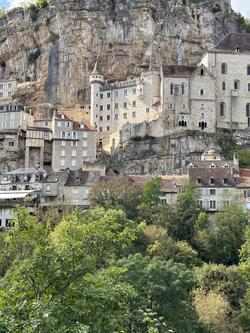
The highlight of the day, Rocamadour suddenly comes into view, perched on its cliff, offering one of the most famous panoramic views in France. A major pilgrimage site for nearly a millennium, this sacred town captivates visitors as much with its spectacular architecture as with its history. The sanctuary, the chapels, the Stations of the Cross, and the castle ramparts combine to create an unforgettable experience, highlighted by breathtaking views of the Alzou Canyon.
This tour is a wonderful way to explore the northern part of the Lot. It will appeal to lovers of history, photography, charming villages, and natural landscapes, while offering a beautiful glimpse of the religious and architectural heritage for which the Dordogne Valley is renowned.
Practical Information
From Les Hauts de Sauliès, explore three gems of the Lot: the Romanesque tranquility of Carennac, the medieval elegance of Martel, and the sacred majesty of Rocamadour. Amid cliffs, bell towers, and narrow streets paved with golden stone, this itinerary blends unspoiled nature, living heritage, and authenticity.
- Carennac – 1 hour and 10 minutes
- Martel – 23 minutes
- Rocamadour – 25 minutes
- Back to Les Hauts de Sauliès – 53 minutes
Map of the route
The Day’s Schedule
Carennac – Travel time: 1 hr 10 min
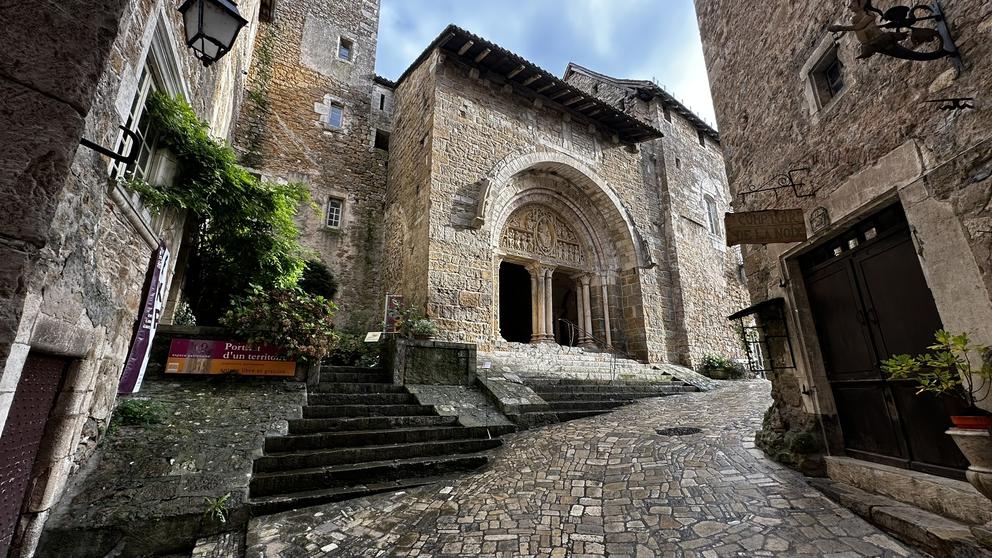
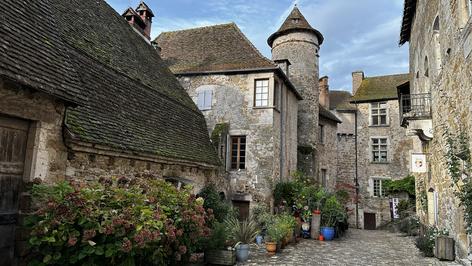
Carennac is a peaceful medieval village on the banks of the Dordogne. Its Romanesque cloister, church, and golden-stone houses exude an atmosphere of great serenity.
St. Peter’s Church
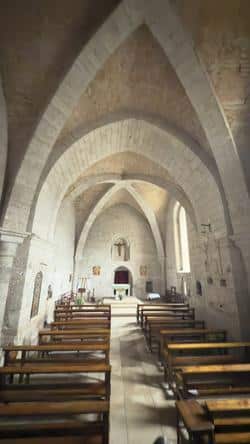
Built in the 11th century at the heart of the Cluniac priory, the Church of Saint-Pierre in Carennac is famous for its Romanesque tympanum depicting Christ surrounded by the apostles and the symbols of the evangelists. Its capitals, adorned with mythical creatures, and its large, uncluttered nave bear witness to the spiritual and artistic richness of the site.
Hours: Free admission
Cloister
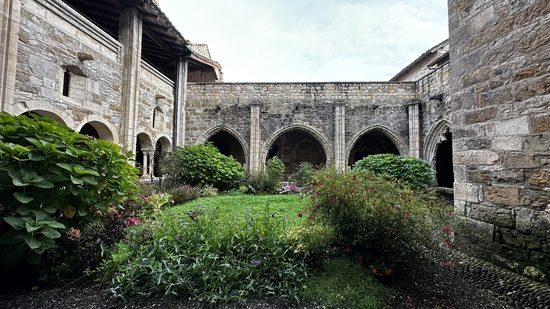
Part Romanesque, part Flamboyant Gothic, the cloister at Carennac offers a peaceful setting conducive to meditation. Its chapter house houses a 15th-century Deposition of Christ, a sculptural masterpiece of striking delicacy, where religious fervor blends with artistic expression.
Hours: 10 a.m. to 12 p.m. and 2 p.m. to 5:30 p.m. (closed Monday through Wednesday) – Contact the tourist office for access
The Deans’ Castle
Overlooking the priory, the Château des Doyens features elegant Renaissance architecture and a 17th-century painted ceiling. Today, it houses the Espace Patrimoine, dedicated to the history, architecture, and art of the Dordogne Valley, featuring both permanent and temporary exhibitions. Hours: 10:30 a.m. to 12:30 p.m. and 2:00 p.m. to 5:30 p.m. (closed Sundays and Mondays)
Martel – Travel time: 23 min
Nicknamed the “City of Seven Towers,” it is a former prosperous trading town. It boasts magnificent medieval buildings and an authentic village atmosphere.
La Raymondie
Built beginning in 1280 by Bernard Raimondi, the royal tax collector, the Raymondie is a vast urban palace organized around an arcaded courtyard. Converted into city hall during the Revolution, it retains its belfry tower, a symbol of seigneurial power. The Gallo-Roman Museum of Uxellodunum, located on the second floor, displays artifacts discovered at the site of the final battle of the Gallic Wars.
The House Known as Fabri
Across from the market hall, the Duboys House—known as the Fabri House—is a medieval residence that was remodeled during the Renaissance; it is recognizable by its windows adorned with pilasters and carved pediments. According to tradition, it stands on the site of the house where Henri Court-Mantel, son of Henry II Plantagenet and Eleanor of Aquitaine, died in 1183.
Saint-Maur Church
Featuring a 16th-century fortified bell tower, the Church of Saint-Maur bears witness to the transition from the Romanesque to the Southern Gothic style. All that remains of the Romanesque structure is a 12th-century tympanum depicting the Second Coming and the Last Judgment. The interior, with its ribbed vault featuring liernes and tiercerons, houses a 16th-century stained-glass window that illuminates the choir.
Rocamadour – Travel time: 25 min
Perched on a dizzying cliff, Rocamadour is a sacred and spectacular place.
For centuries, pilgrims and travelers have come here seeking inspiration, contemplation, and wonder.
📖 Visitor Guide
Sanctuary Plaza
Facing the cliff, the forecourt of the Rocamadour sanctuary is a testament to the ingenuity of its medieval builders, who were able to make the most of a limited space. Once a pilgrims’ cemetery, this forecourt has been enriched over the centuries with chapels and buildings, forming a striking architectural ensemble today.
Lower Church of Saint-Amadour (known as the crypt)
Built at the end of the 12th century, the Church of Saint-Amadour housed the saint’s relics, which were venerated by pilgrims. A masterpiece of balance, it rests on the cliff and supports the basilica above it with a ribbed vault, marking the transition between Romanesque and Gothic architecture.
Basilica of Saint-Sauveur
The largest building in the sanctuary and a UNESCO World Heritage Site, the Basilica of Saint-Sauveur overlooks the crypt. Its two naves and Gothic pillars reflect the desire to expand the space within the cliff to accommodate the crowds of pilgrims who came to pray above the relics of Saint Amadour.
Notre-Dame Chapel
The heart of the pilgrimage, the Chapel of Our Lady of Rocamadour—rebuilt in the 15th century after a rockslide—houses the Black Madonna, an object of devotion for centuries. Built between the basilica and the cliff blackened by candles, it remains the mystical symbol of the sanctuary.
Way of the Cross
As you make your way up toward the castle, the Way of the Cross winds through the vegetation, punctuated by sculpted stations depicting the Passion of Christ. Spectacular views of the valley and the town open up all the way to the Cross of Jerusalem, a lookout point overlooking Rocamadour.
Castle
Perched atop the cliff and overlooking the town, Rocamadour Castle offers a breathtaking view of the Alzou Canyon and the sanctuary. For just a few euros, you can access its panoramic ramparts, the final stop on a spectacular tour—truly the highlight of Rocamadour.

Back to Les Hauts de Sauliès – Travel time: 53 min
If you still have a little time and energy left, you can take a short detour to the Fortified Mill of Cougnaguet, built in the 14th century and still in operation.
Hours: 10 a.m. to 12 p.m. and 2 p.m. to 5 p.m.
💡Our tip
Leave early to enjoy the tranquility of Carennac, which is especially pleasant in the morning. After visiting Martel, head to Rocamadour in the middle of the afternoon, when there are often fewer tour groups. If you can, take the time to climb up to the castle ramparts: the view of the town, the sanctuary, and the Alzou Canyon is absolutely breathtaking.
Before returning to Les Hauts de Sauliès, a detour to the fortified mill at Cougnaguet makes for a lovely way to end this day exploring the heritage of northern Lot.
FAQ
Allow a full day to visit the three villages at a leisurely pace.
Yes. This itinerary was specifically designed to explore Carennac, Martel, and Rocamadour in a single day.
Spring and early fall offer the best conditions, with fewer crowds and pleasant temperatures.
Yes, the tour includes several flights of stairs and a few uphill climbs. However, elevators and a small tourist train help make the hike less strenuous.
Martel offers several restaurants and outdoor dining areas, ideally located in the heart of the old town.
Yes. The fortified mill at Cougnaguet is an excellent detour on the way back.
Extend the experience from Les Hauts de Sauliès
Our prime location in the heart of the Lot region allows you to explore both the Dordogne Valley and the Lot Valley without having to change accommodations. After exploring Rocamadour, Martel, and Carennac, return to the tranquility of the Hauts de Sauliès before continuing your trip to Saint-Cirq-Lapopie, the Pech Merle cave, Cahors, or the Célé Valley—all thanks to our exclusive itineraries designed to help you discover the most beautiful landscapes of Quercy.
To make the most of your stay, check out:
Useful links:
Our other itineraries:
-
The Most Beautiful Hikes in the Lot: 15 Must-See Routes Around the Hauts de Sauliès
Explore the most beautiful trails in the Lot with our selection of 15 must-do hikes. From the cliffs of Saint-Cirq-Lapopie to the Célé and Lot valleys, discover Quercy on foot, surrounded by unspoiled nature.
-
What can you do in Cahors in a day?
Spend a day exploring Cahors on foot as you discover its iconic landmarks, medieval alleyways, Secret Gardens, and the famous Valentré Bridge. A comprehensive itinerary combining heritage, gastronomy, and the art of living in the heart of the capital of the Lot.
-
Visiting Moissac, Lauzerte, and Montcuq: A One-Day Itinerary Between Quercy Blanc and the Way of St. James
Explore Moissac, Lauzerte, and Montcuq—three iconic villages in Quercy where Romanesque heritage, medieval bastides, and rolling landscapes come together. An ideal itinerary for exploring the Way of St. James and the Quercy Blanc region.
-
Visiting Rocamadour, Martel, and Carennac: A One-Day Itinerary in the Dordogne Valley
Set out to explore Carennac, Martel, and Rocamadour—three gems of northern Lot—all part of a one-day itinerary that takes you through medieval villages, exceptional heritage sites, and spectacular panoramic views of the Dordogne Valley.
-
Visit Saint-Cirq-Lapopie, Pech Merle, and the Château de Cénevières: The Must-See Itinerary in the Lot
Discover three of the Lot’s most iconic sites in a single day: the Pech Merle Cave, the village of Saint-Cirq-Lapopie, and the Château de Cénevières. An unmissable itinerary combining prehistory, medieval heritage, spectacular panoramic views, and the Lot Valley.
-
Visiting Figeac, Marcilhac-sur-Célé, and Capdenac-le-Haut: A One-Day Itinerary Combining Cultural Heritage and the Célé Valley
Explore eastern Lot on a route that combines heritage, culture, and stunning landscapes. From the Abbey of Marcilhac-sur-Célé to Figeac and Capdenac-le-Haut, discover the treasures of the Célé Valley and eastern Quercy.
-
Exploring the Lot Valley: A One-Day Itinerary Between Les Arques, Puy-l'Évêque, and Bonaguil Castle
This day trip takes you to the western part of the Lot Valley, where you’ll discover charming villages, medieval heritage sites, remarkable gardens, and legendary fortresses.
-
Visiting Cordes-sur-Ciel, Saint-Antonin-Noble-Val, and the Penne Fortress: A One-Day Itinerary
Discover Cordes-sur-Ciel, Saint-Antonin-Noble-Val, and the fortress of Penne—three medieval gems of Occitanie—all in a single day filled with heritage, panoramic views, and history.
-
Visiting the Castelnau-Bretenoux Castle and Saint-Céré: A One-Day Itinerary in Northern Lot
Let yourself be charmed by one of the most impressive medieval castles in the Lot and stroll through the narrow streets of Saint-Céré. An itinerary that combines heritage, history, and exceptional panoramic views in the heart of the northern part of the department.
-
Visit the Cloup d'Aural Phosphate Mines: A Nature and Heritage Tour in the Heart of Quercy
Immerse yourself in the heart of the Cloup d’Aural and Concots phosphate mines—a unique journey through geological heritage, fossils, nature, and the authentic charm of the Quercy region. An ideal excursion for lovers of science, landscapes, and unusual discoveries.
-
Visiting Najac, Caylus, and the Abbey of Beaulieu-en-Rouergue: A One-Day Itinerary Through the Aveyron Gorges
Explore Najac, Caylus, and the Abbey of Beaulieu-en-Rouergue on a day trip that takes you from a royal fortress to medieval villages and Cistercian heritage sites. An authentic getaway in the heart of the Aveyron Gorges and the Rouergue region.
-
Visiting Villefranche-de-Rouergue and Villeneuve-d'Aveyron: A One-Day Itinerary Through the Heart of the Rouergue Bastides
Set out to discover two magnificent bastides in the Rouergue region on a journey that takes you through medieval heritage sites, Gothic architecture, and charming villages. An ideal excursion to explore another side of Occitanie at the gateway to the Lot.
-
Visiting the Gouffre de Padirac, Autoire, and Loubressac: A One-Day Itinerary in Northern Lot
Discover three of the top must-see attractions in northern Lot: the Gouffre de Padirac, the village of Autoire, and Loubressac. An itinerary that combines spectacular underground landscapes, historic villages, and exceptional panoramic views of the Quercy valleys.
-
Exploring Conques in a Day: A Complete Guide and Itinerary Starting from Les Hauts de Sauliès
Discover Conques, one of the Most Beautiful Villages of France, on a day trip featuring Romanesque heritage, the Camino de Santiago, and exceptional panoramic views. A must-see getaway just outside the Aveyron region.
-
Visiting Sarlat, Souillac, and the Lacave Caves: A One-Day Itinerary Between Périgord and Quercy
Take the time to explore Sarlat, Souillac, and the Lacave Caves on a day trip that combines medieval heritage, Périgord cuisine, and underground wonders. A must-see excursion just outside the Lot region.
Discover more from Les Hauts de Sauliès
Subscribe to get the latest posts sent to your email.