

From Les Hauts de Sauliès, explore three gems of the Lot: the Romanesque tranquility of Carennac, the medieval elegance of Martel, and the sacred majesty of Rocamadour. Between cliffs, bell towers, and golden stone alleyways, this itinerary combines unspoiled nature, living heritage, and authenticity.
- Carennac – 1 hour 10 minutes
- Martel – 23 minutes
- Rocamadour – 25 minutes
- Return to Les Hauts de Sauliès – 53 minutes
Carennac – Travel time: 1 hour 10 minutes
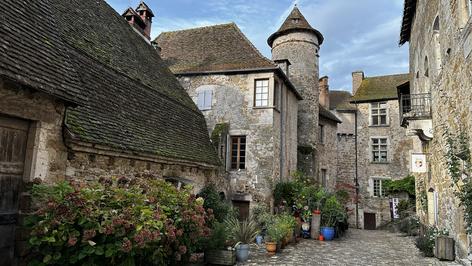
Carennac is a peaceful medieval village on the banks of the Dordogne River. Its Romanesque cloister, church, and golden stone houses exude an atmosphere of great serenity.
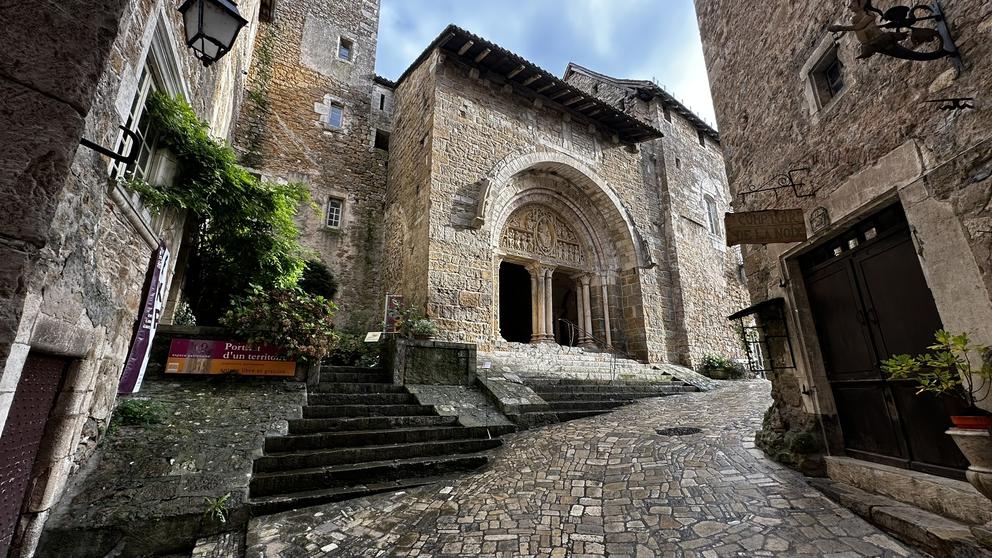
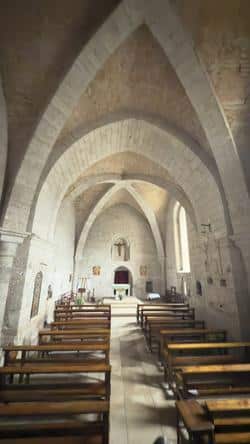
Saint Peter’s Church
Built in the 11th century in the heart of the Cluniac priory, the Church of Saint-Pierre de Carennac is famous for its Romanesque tympanum depicting Christ surrounded by the apostles and symbols of the evangelists. Its capitals adorned with fantastical animals and its large, uncluttered nave bear witness to the spiritual and artistic richness of the place.
Opening hours: free access
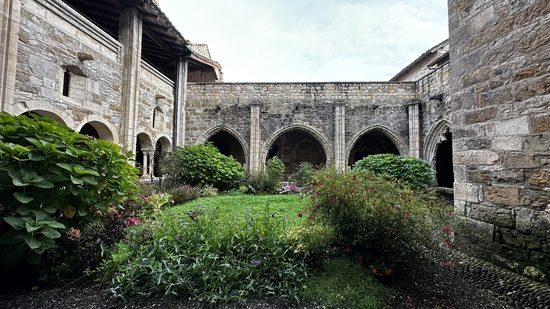
Cloister
Half Romanesque, half flamboyant Gothic, the cloister of Carennac offers a peaceful setting conducive to meditation. Its chapter house houses a 15th-century Entombment, a sculpted masterpiece of striking finesse, where religious fervor blends with artistic expression.
Opening hours: 10 a.m. to 12 p.m. and 2 p.m. to 5:30 p.m. (closed Monday to Wednesday) – Ask for access at the tourist office.
The Dean’s Castle
Overlooking the priory, the Château des Doyens boasts elegant Renaissance architecture and a 17th-century painted ceiling. Today, it houses the Espace Patrimoine, dedicated to the history, architecture, and art of the Dordogne Valley, with permanent and temporary exhibitions. Opening hours: 10:30 a.m. to 12:30 p.m. and 2 p.m. to 5:30 p.m. (closed Sundays and Mondays)
Martel – Travel time: 23 min
Nicknamed the “city of seven towers,” it is a prosperous ancient merchant city. It preserves superb medieval buildings and an authentic village life.
Raymondia
Built from 1280 onwards by Bernard Raimondi, royal tax collector, the Raymondie is a vast urban palace organized around an arcaded courtyard. Converted into a town hall during the Revolution, it retains its belfry tower, symbol of seigneurial power. The Gallo-Roman museum of Uxellodunum, located on the second floor, displays the remains discovered on the site of the last battle of the Gallic Wars.
House known as Fabri
Opposite the market hall, the Duboys house, known as Fabri, is a medieval residence that was renovated during the Renaissance. It is recognizable by its windows adorned with pilasters and sculpted pediments. According to tradition, it stands on the site of the house where Henri Court-Mantel, son of Henri II Plantagenêt and Aliénor d’Aquitaine, died in 1183.
Saint-Maur Church
With its fortified bell tower dating from the 16th century, Saint-Maur Church bears witness to the transition from Romanesque to Southern Gothic architecture. All that remains of the Romanesque building is a 12th-century tympanum depicting the Parousia and the Last Judgment. The interior, with its ribbed vaulting and tiercerons, features a 16th-century stained-glass window illuminating the choir.
Rocamadour – Travel time: 25 min
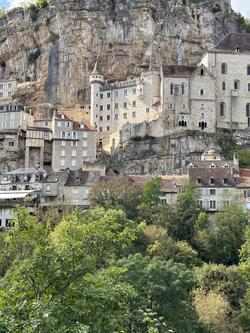
Perched on a vertiginous cliff, Rocamadour is a sacred and spectacular place.
For centuries, pilgrims and travelers have come here seeking inspiration, contemplation, and wonder.
📖 Visitor’s Guide
Sanctuary forecourt
Facing the cliff, the forecourt of the Rocamadour sanctuary impresses with the prowess of its medieval builders, who knew how to make the most of a limited space. Once a pilgrims’ cemetery, this forecourt has been enriched over the centuries with chapels and buildings, forming a striking architectural ensemble today.
Lower Church of Saint-Amadour (known as the crypt)
Built at the end of the 12th century, Saint-Amadour Church housed the relics of the saint venerated by pilgrims. A masterpiece of balance, it rests on the cliff and supports the basilica above thanks to a ribbed vault, a transition between Romanesque and Gothic architecture.
Basilica of Saint-Sauveur
The largest building in the sanctuary and a UNESCO World Heritage Site, the Basilica of Saint-Sauveur towers above the crypt. Its two naves and Gothic pillars reflect the desire to expand the space in the cliff to accommodate the crowds of pilgrims who came to pray over the relics of Saint Amadour.
Chapel of Our Lady
The heart of the pilgrimage, the Chapel of Our Lady of Rocamadour, rebuilt in the 15th century after a landslide, houses the Black Madonna, an object of devotion for centuries. Built between the basilica and the cliff blackened by candles, it remains the mystical symbol of the sanctuary.
Way of the Cross
On the way back up to the castle, the Way of the Cross winds its way through the vegetation, punctuated by sculpted stations depicting the Passion of Christ. Spectacular views of the valley and the town open up as you approach the Jerusalem Cross, a viewpoint overlooking Rocamadour.
Castle
Dominating the town from the top of the cliff, Rocamadour Castle offers breathtaking views of the Alzou Canyon and the sanctuary. For a few euros, you can access its panoramic ramparts, the final stop on a spectacular tour—the real highlight of Rocamadour.

Return to Les Hauts de Sauliès – Travel time: 53 min
If you still have some time and energy left, you can take a short detour to the Fortified Mill of Cougnaguet, built in the 14th century and still in operation today.
Opening hours: 10:00 a.m. to 12:00 p.m. and 2:00 p.m. to 5:00 p.m.
Book your stay now
Our charming rooms | Our Commitment to Responsible Tourism | Other itineraries from Les Hauts de Sauliès | Online booking
Useful links:
-
Exceptional activities and itineraries starting from our guest house near Cahors and Saint-Cirq-Lapopie
Exceptional activities and itineraries starting from Les Hauts de Sauliès Staying at Les Hauts de Sauliès is much more than just choosing a bed and breakfast: it’s treating yourself to a privileged starting point for exploring one of the richest and most unspoiled areas in the Southwest. Located in the Causses du Quercy Regional Park,…
-
Lights of Rouergue: Conques, a Romanesque gem on the Way of St. James from Les Hauts de Sauliès
From Les Hauts de Sauliès, set off to discover Conques, a medieval gem listed as a UNESCO World Heritage Site and an iconic stop on the Way of St. James.Perched on the mountainside and bathed in light, this village in the Rouergue region captivates visitors with its pure architecture, intense Romanesque art, and serene cobbled…
-
Trails and paths of Quercy: walking routes from Les Hauts de Sauliès
From Les Hauts de Sauliès, set off to explore paths carved into the stone and light of the Lot.These hiking trails take you through medieval villages, green valleys, and limestone plateaus, offering sublime panoramic views and the silence of ancient paths.Whether it’s accessible walks around Vers, sporting adventures in the Célé valley, or legendary crossings…
-
Getaway between Périgord and Quercy: Sarlat, Souillac, and Lacave Cave from Les Hauts de Sauliès
From Les Hauts de Sauliès, set off for an unforgettable day at the crossroads of Périgord Noir and Quercy.From the medieval town of Sarlat, a jewel of architecture and art de vivre, to Souillac, gateway to the Lot and bastion of Romanesque art, to the magical caves of Lacave, this itinerary combines heritage, gastronomy, and…
-
On the trails of Rouergue: Caylus, Beaulieu Abbey, and Najac from Les Hauts de Sauliès
From Les Hauts de Sauliès, take the road to medieval Rouergue, a land of history and light.From Caylus, a market town with Gothic facades and arcaded squares, to the Cistercian Abbey of Beaulieu-en-Rouergue, a spiritual center that has become a hub for contemporary art, to Najac, a hilltop village overlooking the Aveyron Gorges, this itinerary…
-
Cities steeped in history and soul: Villefranche-de-Rouergue & Villeneuve-d'Aveyron from Les Hauts de Sauliès
From Les Hauts de Sauliès, set off to explore the bastides and sauvetés of Rouergue, witnesses to a Middle Ages that was both spiritual and commercial.In Villefranche-de-Rouergue, let yourself be enchanted by the arcades of Place Notre-Dame, the splendor of the Chartreuse Saint-Sauveur, and the baroque fervor of the Chapelle des Pénitents Noirs.Continue on to…
-
Highlights of the Tarn and Aveyron regions: Saint-Antonin-Noble-Val, Penne, and Cordes-sur-Ciel from Les Hauts de Sauliès
From Les Hauts de Sauliès, set off to discover the medieval gems of the Tarn and Aveyron regions. From Saint-Antonin-Noble-Val, nestled in a spectacular valley, to the fortress of Penne, perched on its rocky outcrop, to the hilltop town of Cordes-sur-Ciel, this itinerary combines history, art, and nature. Saint-Antonin-Noble-Val – Travel time: 58 min Nestled…
-
In the footsteps of medieval Quercy: Saint-Céré & the Château de Castelnau-Bretenoux from Les Hauts de Sauliès
From Les Hauts de Sauliès, take the road north of the Lot to discover Saint-Céré, a city of art and history with lively streets and medieval charm, before reaching the Château de Castelnau-Bretenoux, an imposing red stone fortress overlooking the Dordogne valley. Saint-Céré – Travel time: 1 hour Nestled in the north of the department,…
-
Between abbeys and hidden valleys: Marcilhac, Figeac, and Capdennac from Les Hauts de Sauliès
From Les Hauts de Sauliès, set off along the roads of Célé and Lot for a day of discovery and serenity. From the Romanesque ruins of Marcilhac-sur-Célé to the medieval streets of Figeac, via the hilltop village of Capdennac-le-Haut, this itinerary invites you to explore places where history, stone, and light combine to create an…
-
Moissac, Lauzerte & Montcuq: cloisters and bastides of Quercy | Les Hauts de Sauliè
From Les Hauts de Sauliès, travel through the Romanesque elegance of Moissac, the medieval poetry of Lauzerte, and the sunny charm of Montcuq. An itinerary where the stone, art, and landscapes of Quercy Blanc cultivate refinement, nature, and authenticity. Moissac – Travel time: 1 hour 10 minutes A city of art and history on the…
-
Treasures of Quercy: Concots & the Cloup d’Aural phosphate mines from Les Hauts de Sauliès
From Les Hauts de Sauliès, set off on a fascinating getaway to the heart of the Causses du Quercy Regional Natural Park. Discover the medieval village of Concots, its rural heritage and authenticity, before enjoying a gourmet break at the Lou Bourdié inn, an iconic address in the Lot region. Finish by exploring the Phosphatières…
-
Stone and light: Carennac, Martel, and Rocamadour from Les Hauts de Sauliès
From Les Hauts de Sauliès, explore three gems of the Lot: the Romanesque tranquility of Carennac, the medieval elegance of Martel, and the sacred majesty of Rocamadour. Between cliffs, bell towers, and golden stone alleyways, this itinerary combines unspoiled nature, living heritage, and authenticity. Carennac – Travel time: 1 hour 10 minutes Carennac is a…
-
Between heaven and earth: Padirac, Autoire, and Loubressac, jewels of the Lot region from Les Hauts de Sauliès
From Les Hauts de Sauliès, set off to discover some of the Lot’s greatest treasures. From the mystical depths of the Gouffre de Padirac to the hanging villages of Autoire and Loubressac, this itinerary immerses you in a setting where stone, water, and light interact in harmony. Padirac Cave – Travel time: 58 min The…
-
Cahors between stone and river: heritage, flavors, and gardens from Les Hauts de Sauliès
The capital of the Lot department, Cahors is a city with a thousand years of history, nestled in a bend of the Lot River. It is famous for its medieval heritage, its black wine with powerful aromas, and its southern lifestyle. The city combines architecture, culture, gastronomy, and nature, between medieval streets and river landscapes.Visitor’s…
-
Journey to the Heart of the Lot: Remarkable Caves, Villages, and a Château from Les Hauts de Sauliès
From Les Hauts de Sauliès, set off on a captivating getaway into the heart of the Regional Natural Park of the Causses du Quercy, where art, history, and preserved nature meet. This one-day itinerary will take you through the decorated caves of Pech Merle, true prehistoric sanctuaries, to the hanging village of Saint-Cirq-Lapopie, a medieval…
Discover more from Les Hauts de Sauliès
Subscribe to get the latest posts sent to your email.